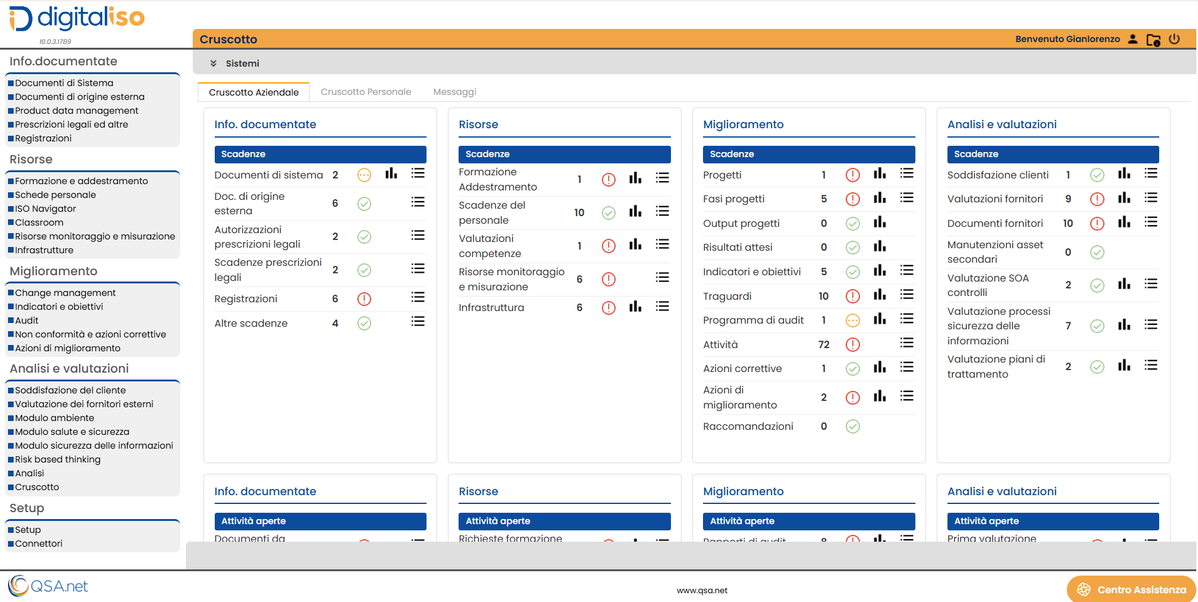
The Digitaliso main menu is organised into four main sections, each dedicated to specific processes within the Management System. Each section includes ready-to-use features that can be configured via the Setup menu, enabling the coordinated management of documents, data, notifications, reminders, reports and indicators.
Documented information
System Documents
It manages the entire lifecycle of manuals, procedures and forms, automating their amendment, verification, approval, release and archiving.
✦ With Ammira, documentation becomes a knowledge base that users can search.
External documentes
It manages documents from external sources, such as regulations, safety data sheets, specifications, technical manuals and authorisations.
Product Data Management
Link drawings, technical data sheets and system or externally sourced documents to the products and services to which they relate, creating a single point of access.
Legal requirements
It manages the applicable regulatory requirements, linking deadlines, responsibilities, authorisations and supporting documentation to each requirement.
✦ HSE Navigator supports the interpretation of regulations and links to Environment and Safety.
Records
It manages registers, data and process records in a structured manner, with controlled access and reminders.
With customised web apps, you can collect data directly in the field – even using tablets and smartphones – moving beyond Excel spreadsheets and unstructured records.
The information collected can be used to generate dashboards and reports, improving process control, reducing errors and supporting audits and reviews.
Resources
People and competences
It manages the entire lifecycle of training activities, automating and streamlining training management whilst reducing paper usage and administrative burdens.
Personnal records
It centralises staff personal, operational and professional details, linking roles, job descriptions, skills, training and deadlines to each employee.
Classroom
An area dedicated to the archiving of training courses and teaching materials.
It serves as an internal library for training content and can include self-study materials.
Monitoring and measurement
It enables the mapping of instruments, the creation of detailed data sheets and the recording of calibration or verification procedures.
Infrastructure
Centralise the management of equipment, plant and vehicles by creating dedicated records and scheduling maintenance based on frequency or usage.
It monitors deadlines and tasks, keeps a record of activities and supports data collection, including from mobile devices.
It enables a more proactive approach to maintenance, reduces the need for breakdown repairs and improves the monitoring and traceability of assets.
Improvement
Change Management
Designed to manage and monitor the progress of business projects. It enables you to define phases, resources, related documentation, objectives, costs and timelines.P
Objectives and KPI’s
It enables you to monitor business objectives and performance indicators, providing an immediate overview of how business processes are performing.
Audit
It manages the planning, execution and reporting of audits, automating and centralising information and documentation.
Non-conformities and corrective actions
It manages the entire lifecycle of non-conformities, complaints, near misses and corrective actions through a structured process based on the 8D methodology.
✦ NC Navigator supports the user right from the moment a report is opened, analysing unstructured information (emails, free-form text, attachments) to identify the type of incident, map it against company configurations and suggest a pre-filled form. During the management phase, it suggests immediate containment measures, guides the root cause analysis (using methodologies such as 8D or the 5 Whys) and facilitates the proactive generation of corrective actions.
Actions to address Risk/Opportunities
It manages actions to address risks and opportunities, transforming improvement initiatives into a structured and monitorable process.
Plan activities, assign responsibilities, monitor deadlines and progress, and assess the effectiveness of actions
Analysis and assessment
Customer satisfaction
It manages and monitors customer perception using integrated tools, internal self-assessment questionnaires and a portal for direct interaction with customers via the NPS methodology.
Assessment of external suppliers
It manages the qualification and assessment of external suppliers, improving proactive monitoring of document deadlines and the tracking of supplier performance.
Risk Based Thinking
It supports the management of risks and opportunities through structured data and analytical tools, enabling organisations to monitor how these evolve and assess the effectiveness of their actions over time.
Data analysis
It provides tools for performance monitoring and data analysis, using indicators and summary tables based on the information collected in Digitaliso.
Dashboard
It centralises the monitoring of deadlines and task completion times, processing the data collected from the platform’s various modules in real time.
Accessible directly from the main menu, it powers the customisable notification service, sending information and reminders to interested users directly to their inbox.
A platform that adapts and integrates
Digitaliso can be tailored to the organisation’s specific circumstances and integrate with other business systems.
Setup
It enables you to tailor Digitaliso to your organisation’s structure and processes by configuring systems, workflows, terminology and the platform’s key settings. These configurations can evolve over time in line with your business needs.
Connettori
They enable Digitaliso to be connected to external data sources, synchronising master data and information or importing data via Excel and CSV files. They reduce duplication and the need for manual re-entry, facilitating the exchange of data with other business systems.